If a contractor has ever mentioned “decking,” “flashing,” or “ice and water shield” and you nodded along without really knowing what they meant, this roofing terms glossary is for you. Understanding basic roofing vocabulary helps you read estimates accurately, ask sharper questions, and avoid getting upsold on something you don’t actually need. Below are the 12 roofing terms every St. Louis homeowner should know before their next inspection, repair, or replacement.
Why This Roofing Terms Glossary Matters Before You Get a Quote
Roofing contractors often assume homeowners already know the vocabulary — and that gap is exactly where miscommunication (and overpriced add-ons) happens. Keeping a roofing terms glossary handy means you can compare quotes line by line instead of just trusting a bottom-line number.
The Roofing Terms Glossary: 12 Words Every Homeowner Should Know
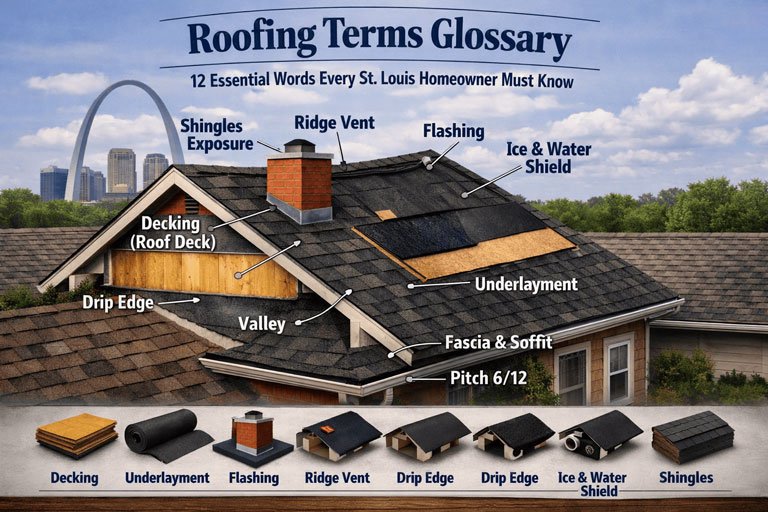
1. Decking (Roof Deck)
The plywood or OSB board layer fastened to your roof trusses that everything else — underlayment, shingles, flashing — is installed on top of. Rotted or water-damaged decking is a common hidden cost during a roof replacement.
2. Underlayment
A water-resistant layer installed directly on the decking, beneath the shingles. It acts as a secondary barrier against moisture if wind-driven rain gets under the top layer of roofing.
3. Flashing
Thin metal strips installed around roof penetrations — chimneys, vent pipes, skylights — and along roof valleys to direct water away from seams. If there’s one term in this roofing terms glossary worth remembering, it’s this one: reused or improperly installed flashing is one of the leading causes of roof leaks.
4. Ridge Vent
A ventilation component installed along the peak (ridge) of the roof that allows hot, humid attic air to escape. Proper ridge ventilation extends shingle life and helps regulate attic temperature year-round.
5. Drip Edge
A metal edging installed along the eaves and rakes of the roof that directs water into the gutters instead of behind the fascia. It’s inexpensive but critical for preventing wood rot at the roof’s edge.
6. Ice and Water Shield
A self-adhering waterproof membrane installed along eaves, valleys, and around penetrations — especially important in Missouri, where freeze-thaw cycles and ice dams can force water backward under shingles.
7. Square (Roofing Square)
A unit of measurement contractors use to price roofing jobs, equal to 100 square feet of roof area. When you see roofing quoted “per square,” this is the unit being referenced — one of the most misunderstood entries in any roofing terms glossary.
8. Pitch (Roof Slope)
The steepness of a roof, expressed as a ratio (like 6/12), meaning the roof rises 6 inches for every 12 inches of horizontal run. Pitch affects material options, labor cost, and drainage.
9. Valley
The internal angle where two roof slopes meet, channeling water down toward the gutters. Valleys see heavy water flow and are a common spot for leaks if flashing isn’t installed correctly.
10. Fascia
The vertical board that runs along the edge of the roofline, typically where gutters are mounted. Fascia damage often signals a drip edge or gutter issue that’s been going unaddressed.
11. Soffit
The material covering the underside of the roof overhang, connecting the fascia to the exterior wall. Soffits usually include ventilation to help air circulate through the attic.
12. Shingle Exposure
The portion of each shingle left visible after installation (the rest is overlapped by the row above). Incorrect exposure can shorten a shingle’s wind resistance and lifespan.
How to Use This Roofing Terms Glossary on Your Next Estimate
Next time a contractor walks you through a quote, ask them to point out where each of these 12 terms shows up — decking condition, underlayment type, flashing plan, ventilation, and drip edge. A contractor who can explain their scope of work using this vocabulary (instead of glossing over it) is usually one who’s being transparent about what you’re paying for.
If you want a written estimate that spells out every one of these terms in plain language, request a free roof inspection from Tulley Contracting Services — we walk every homeowner through their scope of work line by line. You can also see how these components come together on our roofing services page or check out real St. Louis roofing projects in our gallery.
Sources and Further Reading
- National Roofing Contractors Association (NRCA) — Roofing Terminology — industry-standard definitions and technical resources
- International Building Code (ICC) — Roofing Requirements — code-level standards referenced in roofing terminology
- City of St. Louis Building Permits — local permitting requirements for roofing work