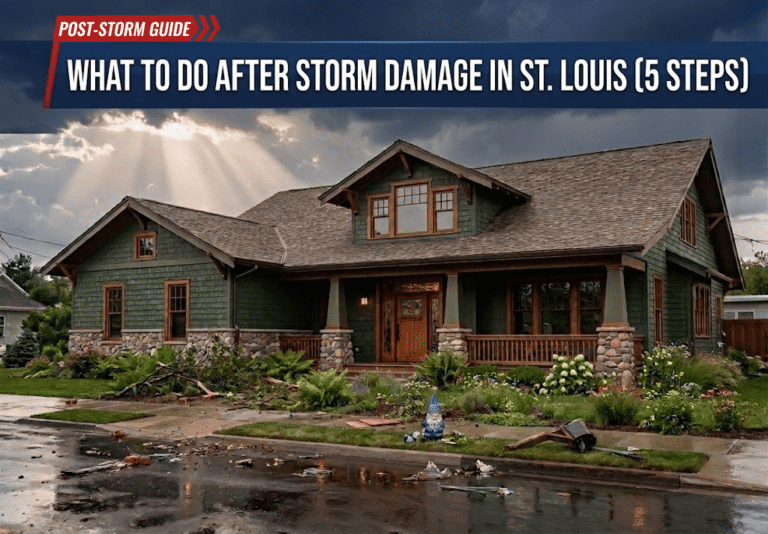
What to Do After Storm Damage in St. Louis (5 Essential Steps)
The morning after a bad storm usually starts the same way for most St. Louis homeowners: coffee in hand, stepping outside to see what’s left. Maybe it’s a few shingles in the yard. Maybe it’s a gutter hanging off one corner of the house, or a tree limb resting on the garage roof. Whatever it looks like, the next few days matter more than people expect. How you handle storm damage in St. Louis in that first week often decides whether the repair goes smoothly or turns into months of back-and-forth with an insurance company.
Handling storm damage in St. Louis well isn’t about following a checklist pinned to a fridge — it’s about following the order most experienced contractors and adjusters actually recommend, based on what tends to go wrong when homeowners skip a step or rush ahead too fast.
First, Walk the Property — Not Just the Roof
It’s tempting to grab a ladder and head straight for the roof, but that’s usually not where the real danger is. Power lines come down more often than people realize during high-wind events, and a line that looks dead isn’t necessarily dead. If you see one anywhere near the house, the driveway, or the yard, keep everyone away from it and call it in rather than trying to move it yourself.
Trees are the other thing people underestimate. A limb that’s cracked but still hanging can come down hours or even a full day later, especially if there’s another round of wind behind the first storm. If a tree near the house looks compromised, treat that whole area as off-limits until someone can assess it properly.
Once you’ve ruled out the obvious hazards, then it’s worth a careful look at the roofline from the ground. Binoculars work fine for this. You’re mainly looking for missing sections, obvious dents, or anything that looks out of place compared to how the roof normally sits.
Take More Photos Than You Think You Need
This is the step that ends up mattering most once the insurance conversation starts, and it’s also the one people rush through because they’re eager to start cleaning up.
Photograph the roof from all four sides before you touch anything. Get close-ups of individual shingles if you can safely see them, along with any dents in the gutters, siding, or window screens. If a tree fell, photograph exactly where it landed and how it’s resting against the structure — insurance adjusters often want to understand the mechanics of how damage happened, not just what the end result looks like.
Inside the house, check ceilings in every room, even ones that seem unaffected. Water doesn’t always show up where you’d expect, and a small brown ring today can be a soaked insulation problem two weeks from now. Note the date of the storm somewhere you won’t lose it — a text to yourself works fine — because insurers will ask, and “sometime last week” isn’t a great answer when you’re trying to match your claim to a specific weather event.
Get a Professional Inspection for Storm Damage in St. Louis Before You Assume It’s Minor
Here’s the part that surprises a lot of homeowners: hail damage frequently doesn’t look like damage at all from the ground, or even from a quick walk on the roof. It bruises the shingle mat underneath the surface, which weakens the material without necessarily cracking it or knocking anything loose. A roof can take a serious hail hit and still look completely normal for months before the granule loss starts showing up as bald patches or the shingle starts curling early.
This is really the argument for getting a professional inspection for storm damage in St. Louis rather than relying on your own read of the situation. Someone who inspects roofs across Franklin County and the surrounding St. Louis region — towns like Washington, Union, Pacific, and St. Clair all see their share of hail and wind events most seasons — knows the difference between cosmetic wear and the kind of impact damage that shortens a roof’s life. That distinction ends up being the whole ballgame when it comes to what your insurance company is willing to cover.
Ask for the inspection findings in writing. Not because you need to double-check the contractor, but because a written report becomes part of the record you’ll hand to your insurer.
If There’s an Opening in the Roof, Don’t Wait to Cover It
If the storm left a hole, tore off a section of shingles, or lifted flashing badly enough that you can see the roof deck underneath, that’s not something to leave alone until the insurance process wraps up. Rain doesn’t pause for paperwork, and a small opening today can mean soaked insulation, sagging drywall, or mold growth by the time repairs actually start.
A proper tarp job isn’t a tarp thrown over the spot and weighted down with a couple of bricks — it needs to be anchored well enough to survive the next round of wind, which is common in the days following a major storm system. Most insurance policies also expect homeowners to take reasonable steps to prevent damage from getting worse after a covered event, so tarping isn’t just about comfort. It protects the claim, too.
Sorting Out the Insurance Piece for Storm Damage in St. Louis
Once you’ve got documentation and a written inspection, filing an insurance claim for storm damage in St. Louis is fairly straightforward: give your insurer the storm date, your photos, and the contractor’s report. Where it gets complicated is what happens after the adjuster comes out.
Adjusters see a lot of roofs in a short window after a big storm, and it’s not unusual for their assessment to miss damage that a specialist would catch — particularly hail bruising in shaded valleys or areas that are harder to access. If your contractor’s findings and the adjuster’s report don’t line up, it’s completely reasonable to ask for a second look or a supplement to the claim rather than accepting a scope that feels incomplete. Homeowners do this more often than you’d think, and it’s rarely contentious when the documentation backs it up.
Standard homeowners insurance generally covers wind and hail damage but excludes flooding — that requires a separate flood policy, and it’s worth checking the Federal Emergency Management Agency’s flood insurance guidance if any of your damage involves water coming up from ground level rather than down through the roof.
As for who does the actual repair: after any large storm event, it’s common to see unfamiliar trucks and door hangers from crews that showed up specifically because of the storm and will be gone once the season slows down. That’s not automatically a red flag, but it does mean any warranty they offer is only as good as their willingness to still be around next spring. A contractor with a permanent local presence — a real office, a track record in the community, references you can actually call — carries more weight than a low bid from someone passing through.
Repair or Full Replacement After Storm Damage in St. Louis?
Not every storm-damaged roof needs to come off entirely, and not every damaged roof should just be patched, either. A handful of missing shingles or one section of lifted flashing is usually a straightforward repair. But if the damage is spread across multiple slopes, if the roof was already close to the end of its lifespan, or if this is the second or third storm season it’s taken a hit, a repair often ends up being a short-term fix that costs more in the long run than doing the replacement once.
A good inspection report should spell out which category applies and explain the reasoning, not just hand you a recommendation. If a contractor tells you it needs full replacement without walking you through why a repair wouldn’t hold, that’s a fair thing to ask about directly.
Preparing for the Next Round of Storm Damage in St. Louis
Once repairs wrap up, it’s worth a short conversation about what could reduce the damage next time. Impact-resistant shingles hold up meaningfully better against hail than standard architectural shingles, and some insurers offer a premium discount for installing them. Good attic ventilation matters more than people assume — heat and trapped moisture quietly shorten a roof’s life even without a single storm involved. And a once-a-year inspection, or one after any major weather event, tends to catch small problems while they’re still cheap to fix.
Storm damage in St. Louis isn’t a matter of if but when, given how often this region sees hail and high wind. The homeowners who come out of it with the least stress are usually the ones who moved through these steps in order — safety first, documentation before cleanup, a real inspection before assuming the damage is minor, and a contractor who’s actually going to be around to stand behind the work.
Need Help With Storm Damage in St. Louis?
Tulley Contracting Services provides free inspections for storm damage in St. Louis and throughout Franklin County, and works directly with insurance adjusters to keep the claims process moving. Get in touch to schedule a visit.